KMXD · AI Product · Live at getmeetprep.com · AI-Native SaaS in Active Development
MeetPrep: Designing an AI-Native Meeting Intelligence Platform
MeetPrep began as an AI-powered workflow that generated executive-quality meeting briefings before important conversations. Through extensive testing and iteration, it has evolved into a broader exploration of AI-native product design, focused on user trust, progressive disclosure, information architecture, decision-support UX, and executive-quality interaction design.
The briefing engine, onboarding flow, landing page, and design system are live at getmeetprep.com. What remains, in-app result display, download and share options, and a pricing model, is currently paused while I focus full-time on GridParse.AI.
Try it yourself, live and working.
Try MeetPrep →🚧 Work in Progress: The onboarding flow, landing page, and design system are live at getmeetprep.com. The next phase focuses on in-app briefing display, download and share options, and monetization.
No 1Overview
What this is
MeetPrep is an AI-native meeting intelligence platform that helps professionals prepare for high-stakes conversations through structured, executive-quality briefings. It combines AI-assisted reasoning, product design, and decision-support UX to transform scattered meeting context into clear, actionable preparation.
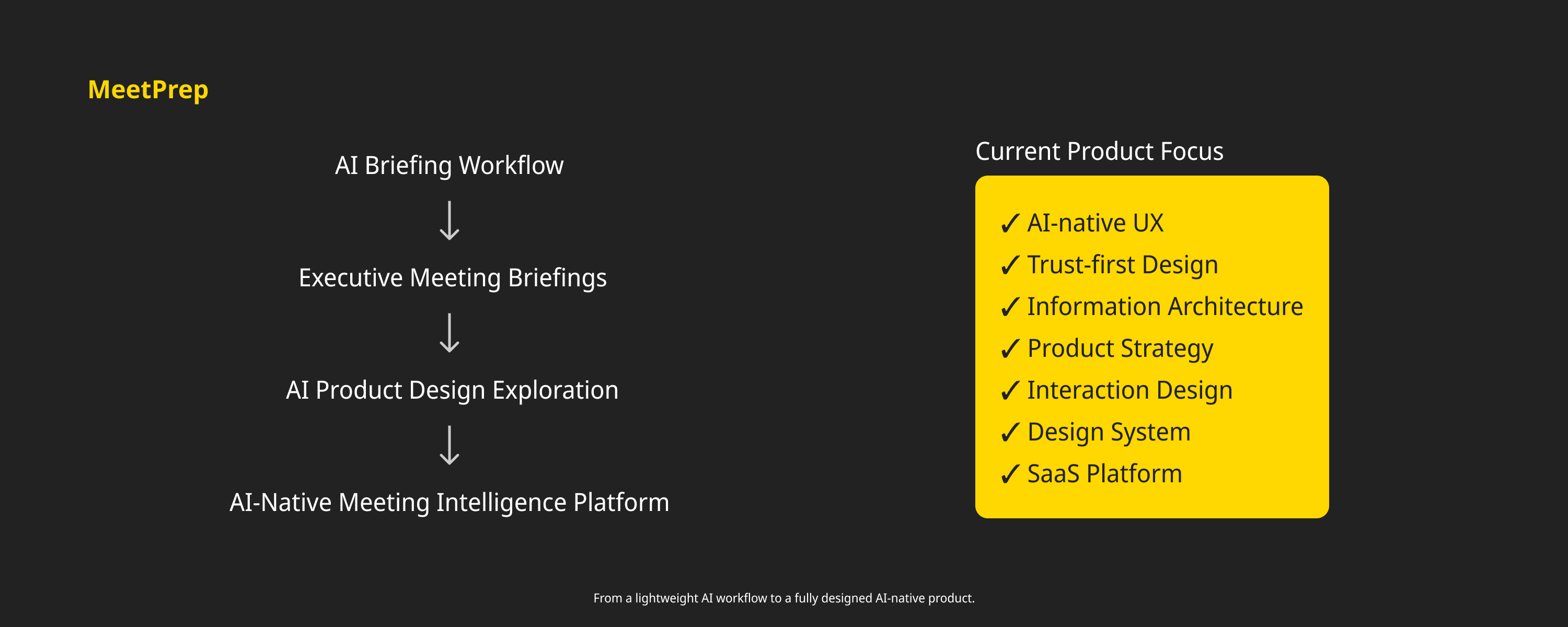
The project began as a lightweight AI workflow and has since evolved into a broader product design initiative exploring AI-native onboarding, information architecture, trust-building interactions, progressive disclosure, product strategy, and human-centered AI experiences.
Rather than functioning as a research assistant, MeetPrep is designed to feel like an experienced meeting strategist, preparing you moments before an important conversation while remaining transparent about uncertainty and avoiding fabricated confidence.
Why I built this
I kept showing up to important conversations underprepared, not because the information did not exist but because pulling it together took more time than I had. I wanted something that could take whatever I knew about a person or company and turn it into a sharp, scannable brief I could read in 30 to 60 seconds.
I have used it personally before every significant meeting for months. It works well enough that I wanted to build it properly and share it.
Who it is for
Anyone preparing for a job interview, a sales conversation, a partnership meeting, a recruiter call, or a high-stakes internal sync. The tool is designed to be useful whether you have deep background on the person or almost nothing at all.
Core design tension
The hardest problem in meeting intelligence is not generating output. It is generating output that is useful without being dishonestly confident. When context is limited, AI systems tend to fill gaps with plausible-sounding but ungrounded detail. MeetPrep is designed to surface what it knows, what it inferred, and what is missing, so the user can make better judgments rather than just trusting the output blindly.
Current product focus
The AI briefing engine is considered production-ready after extensive prompt engineering and scenario testing. Current work has shifted from optimizing prompts to designing MeetPrep as a complete AI-native SaaS platform.
What's genuinely left, currently paused while I focus full-time on GridParse.AI:
- In-app result display, so briefings show up in the product itself instead of email-only
- Download and share options for a completed briefing
- A pricing model
The goal is to create an AI product that feels intentionally designed from the very first interaction, rather than simply wrapping a language model with a form.
No 2Problem
MeetPrep started with a simple question: How do you help someone walk into an important conversation feeling genuinely prepared rather than simply informed?
The challenge turned out to be much larger than summarizing publicly available information. Most AI products can generate content. Far fewer help people make better decisions under uncertainty. Designing for trust, clarity, and action became a fundamentally different product problem than simply generating text.
The real product challenge
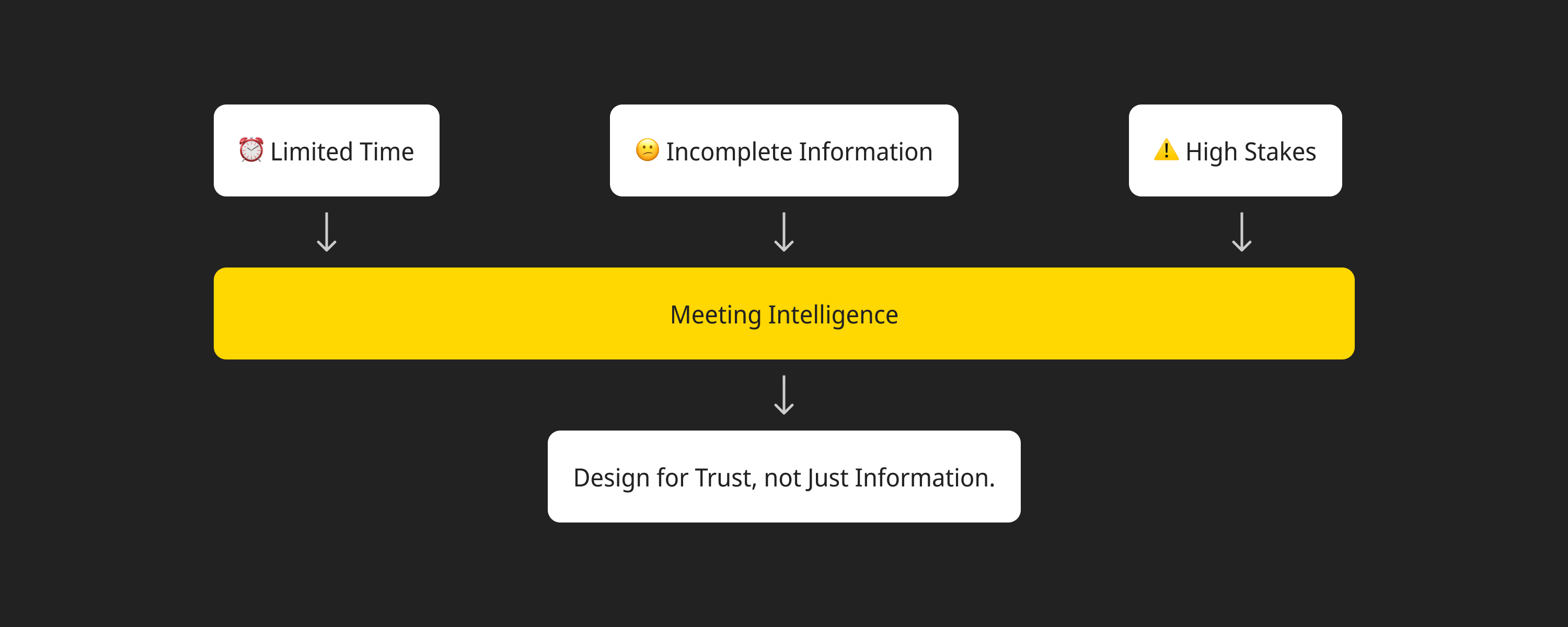
Meeting preparation is constrained by three variables that rarely exist together:
- Limited time before the meeting.
- Incomplete or inconsistent information.
- High consequences if the preparation is wrong.
Most existing workflows optimize for collecting information. MeetPrep instead focuses on helping users make better decisions with whatever information is actually available.
Why AI changes product design
Traditional software produces deterministic outputs. AI systems are probabilistic. The same input can generate different responses, making consistency, transparency, and user trust central design problems rather than technical implementation details.
This shifted the project away from building an automation workflow and toward designing an AI-native product where interaction design, prompt architecture, information hierarchy, and confidence signaling all work together to support better decision-making.
Design principles that emerged
- Optimize for decisions, not information.
- Expose uncertainty instead of hiding it.
- Teach users how to provide better context.
- Reward quality inputs with noticeably better outputs.
- Make AI reasoning understandable without overwhelming the user.
- Build trust through interaction design rather than marketing claims.
The biggest challenge was never generating meeting briefings. It was designing an AI product that users could confidently rely on before high-stakes conversations.
No 3Designing for Trust in AI Systems
While building and testing MeetPrep, the most valuable insights came less from software bugs and more from observing how people interacted with probabilistic AI.
These recurring behaviors became product design challenges rather than engineering defects. Instead of trying to eliminate them completely, the product was redesigned to help users understand and navigate them more effectively.
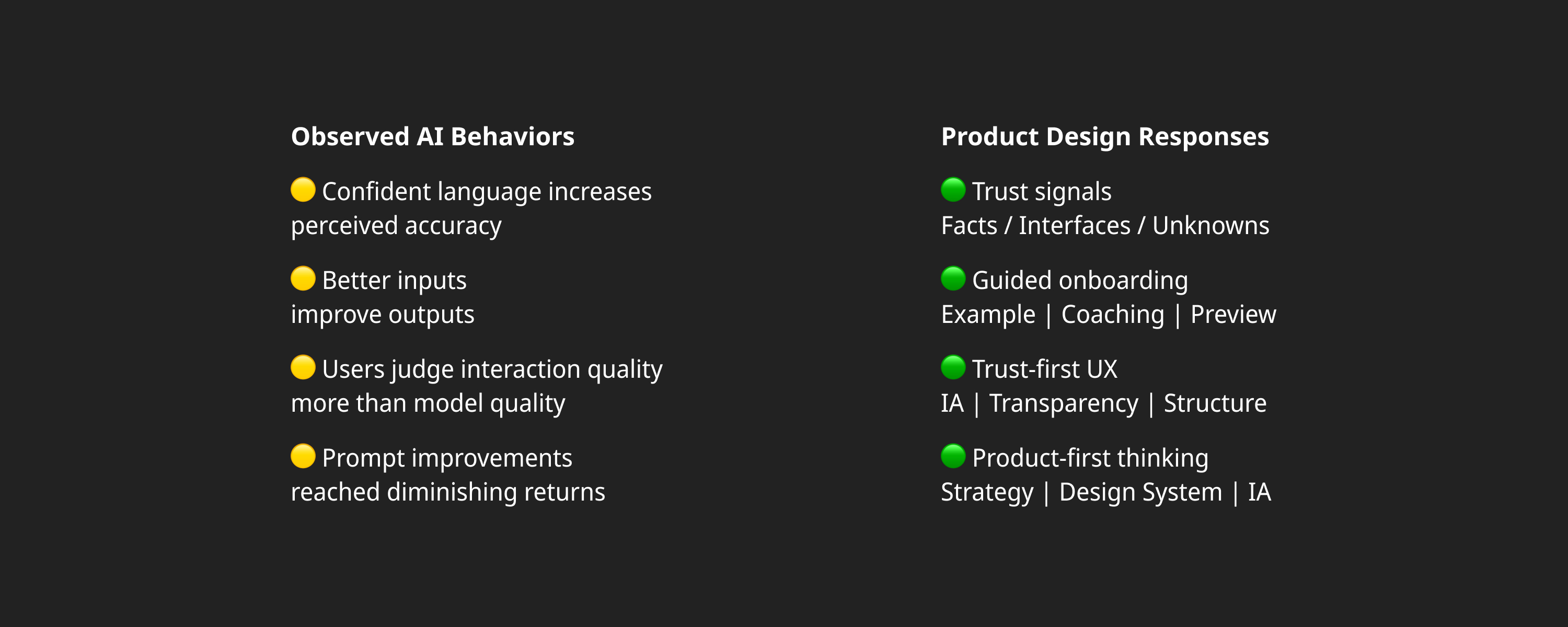
Behavior 1: Confident language increases perceived accuracy
Users naturally trust information that sounds specific and well written, even when the underlying evidence is limited.
Product response: Separate known facts from inferred observations and explicitly communicate uncertainty wherever appropriate.
Behavior 2: Better inputs produce exponentially better outputs
Small improvements in meeting context consistently produced significantly more useful executive briefings.
Product response: Redesign onboarding to educate users with contextual examples, progressive disclosure, and real briefing previews before asking for information.
Behavior 3: Users evaluate AI through interaction quality, not model quality
Trust was influenced less by the underlying language model and more by how the experience explained uncertainty, structured information, and guided user decisions.
Product response: Shift product investment from prompt optimization toward interaction design, information architecture, onboarding, and trust-first UX.
Behavior 4: Prompt engineering eventually reaches diminishing returns
After extensive prompt iteration, improvements became increasingly incremental. The largest opportunities for better outcomes were no longer inside the prompt itself, but within the surrounding product experience including onboarding, interaction design, user education, information architecture, and trust-building mechanisms.
Product response: Treat prompt engineering as one layer of a larger AI product system and redesign the surrounding experience to improve user outcomes rather than only model outputs.
The most important lesson from MeetPrep was that trustworthy AI products are designed through product strategy, interaction design, and user education as much as through model quality.
No 4Product Design Decisions
The behaviors observed during testing directly informed product decisions across onboarding, interaction design, output structure, and AI system behavior. Rather than relying solely on prompt engineering, MeetPrep was redesigned around mechanisms that improve trust, transparency, and decision quality.
Shift from Output Generation to Output Governance
The system is not designed to "sound smart"
It is designed to stay correct under uncertainty
Prompt as System Layer
The prompt is treated as a governed system layer, not a one-off input
→ Explicit rules define what the system can and cannot say
→ Encodes behavior, constraints, and structure across runs
→ Reduces instability and prevents fabricated specificity
Anti-Hallucination Logic
The system is instructed to default to "unknown" over guessing
→ No inferred roles unless explicitly stated
→ No invented company or personal details
Trust Signal Layer
Every brief closes with a single holistic confidence rating
→ 🟢 High confidence
→ 🟡 Moderate confidence
→ 🟠 Limited confidence
→ An honest read on how much the system had to work with, not a line-by-line audit of every statement
Separating Reasoning from Writing
The backend runs two distinct AI passes, not one mega-prompt
→ One model analyzes context and produces structured "Conversation Intelligence"
→ A second model takes only that structured output and writes the final formatted brief
→ Reasoning and presentation stay as separate, independently improvable layers
Live Web Lookup Before Reasoning
A Firecrawl step searches the web for the person or company before either AI pass runs
→ Grounds the briefing in current, real information instead of relying on the model's training data alone
→ Feeds directly into the reasoning pass, not the writing pass
Placed Trust, Not Just Promised It
Rather than a generic privacy policy link
→ Reassurance copy sits directly next to the specific fields most likely to raise hesitation, like personal context about the other person
→ Explains exactly why that data is needed and that it isn't shared or reused
Real Frontend Engineering, Not Just Visual Design
The multi-step intake flow includes genuine client-side validation, built in vanilla JS, no framework
→ Required-field enforcement
→ Email and URL format checking
→ Live error-clearing as the user types
Explicit Missing Context
Gaps are surfaced, not hidden
→ "Role unknown" becomes part of the output
→ Enables better human judgment instead of blind trust
Structured Output with Defined Quality
Output is broken into predictable, scannable blocks
→ Quick Prep, Actions, Leverage, Context, Trust
→ Good output is not subjective: skimmable in 60 seconds, facts separated from assumptions, every section drives toward action
Making Failure Legible
Failures are designed to be visible in the output
→ Missing data, low confidence, weak signals
→ Turns black-box behavior into inspectable output
These same interventions informed real product work.
At ChatFin, where I consult as a Product Design partner, I applied the same principles to the platform's AI agent: adding trust signal layers, surfacing missing context explicitly, and structuring outputs for faster financial decision-making.
The challenge in both cases was identical: how do you make AI output useful without making it dishonestly confident?
No 5Production System
From Prompt to System Behavior
What began as a single AI prompt evolved into a governed product system
→ Behavior is now predictable, inspectable, and constrained
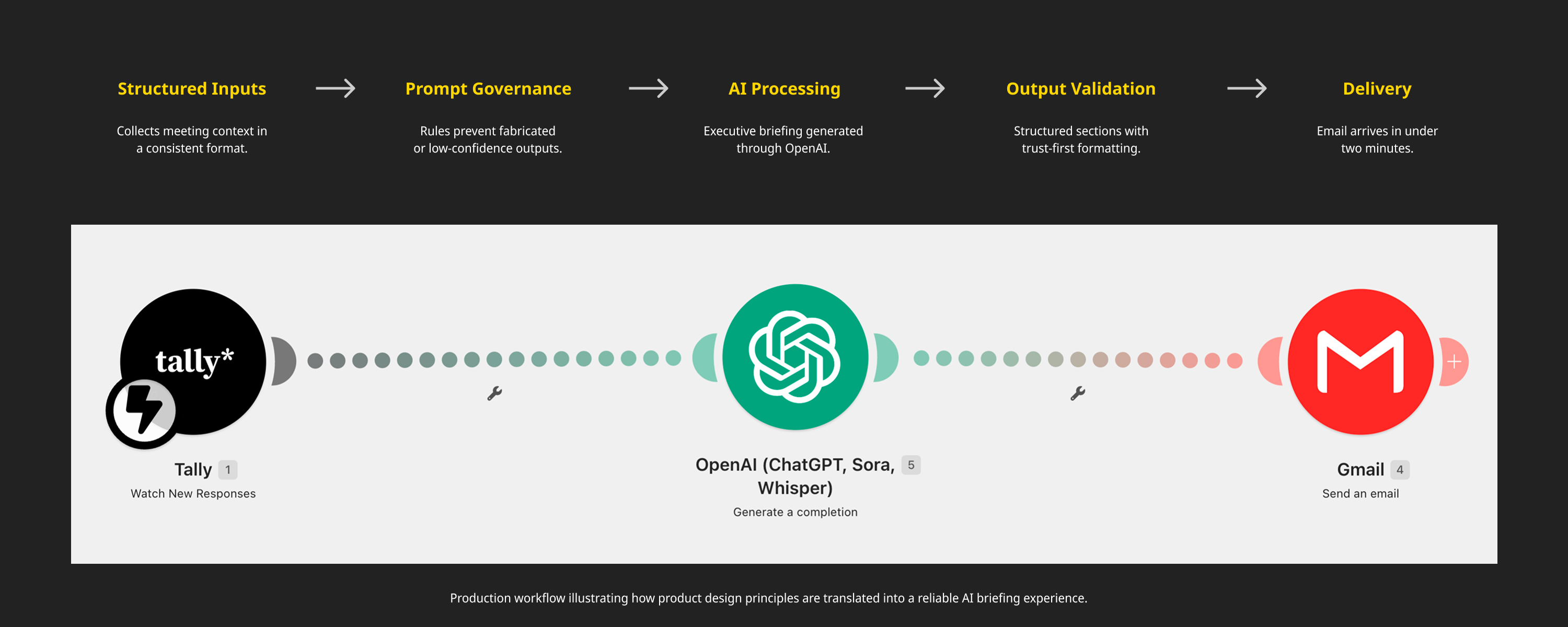
End-to-End Workflow
Trigger → AI Processing → Structured Email Output
→ Simple pipeline, tightly controlled at the generation layer
Designed for 30 to 60 Second Consumption
Output prioritizes speed over depth
→ Key signals surface instantly
→ No dense paragraphs, no cognitive overload
Structured for Action, Not Just Insight
Every section drives toward a decision
→ "What You Should Do" is the core, not an afterthought
Transparent and Stable by Default
The system exposes its reasoning through trust signals and explicit gaps
→ Handles ambiguity without breaking
→ Degrades gracefully when data is missing instead of fabricating details
From v1 to v3: Three Iterations, Not One Build
v1 shipped first, Tally → Make → OpenAI → Gmail, a lightweight pipeline that proved the AI could generate genuinely useful briefings
→ v2 was never public, a cloned scenario used purely to harden input validation before touching production
→ v3 replaced the polling-based trigger with a webhook, and is the version now running behind getmeetprep.com's live wizard today
→ Handles variable input quality including missing LinkedIn and vague context, delivering structured briefings to any email in under two minutes
→ Refined through extensive iterative testing across real meeting scenarios
Testing With Planted Details
Rather than generic dummy data, test scenarios included one specific planted detail
→ e.g. a stated prior negative vendor experience, or a personal connection to someone at the company
→ Verified the AI actually used that detail rather than defaulting to generic advice
Real bugs, found and fixed during the getmeetprep.com migration:
A stale trigger and field-mapping bug where the automation platform read an outdated data structure, silently leaving fields blank in the output. An unclosed CSS block that silently broke typography and spacing site-wide until root-caused. A brittle date-handling approach fixed by switching to a platform-native "current time" function instead of relying on submission metadata.
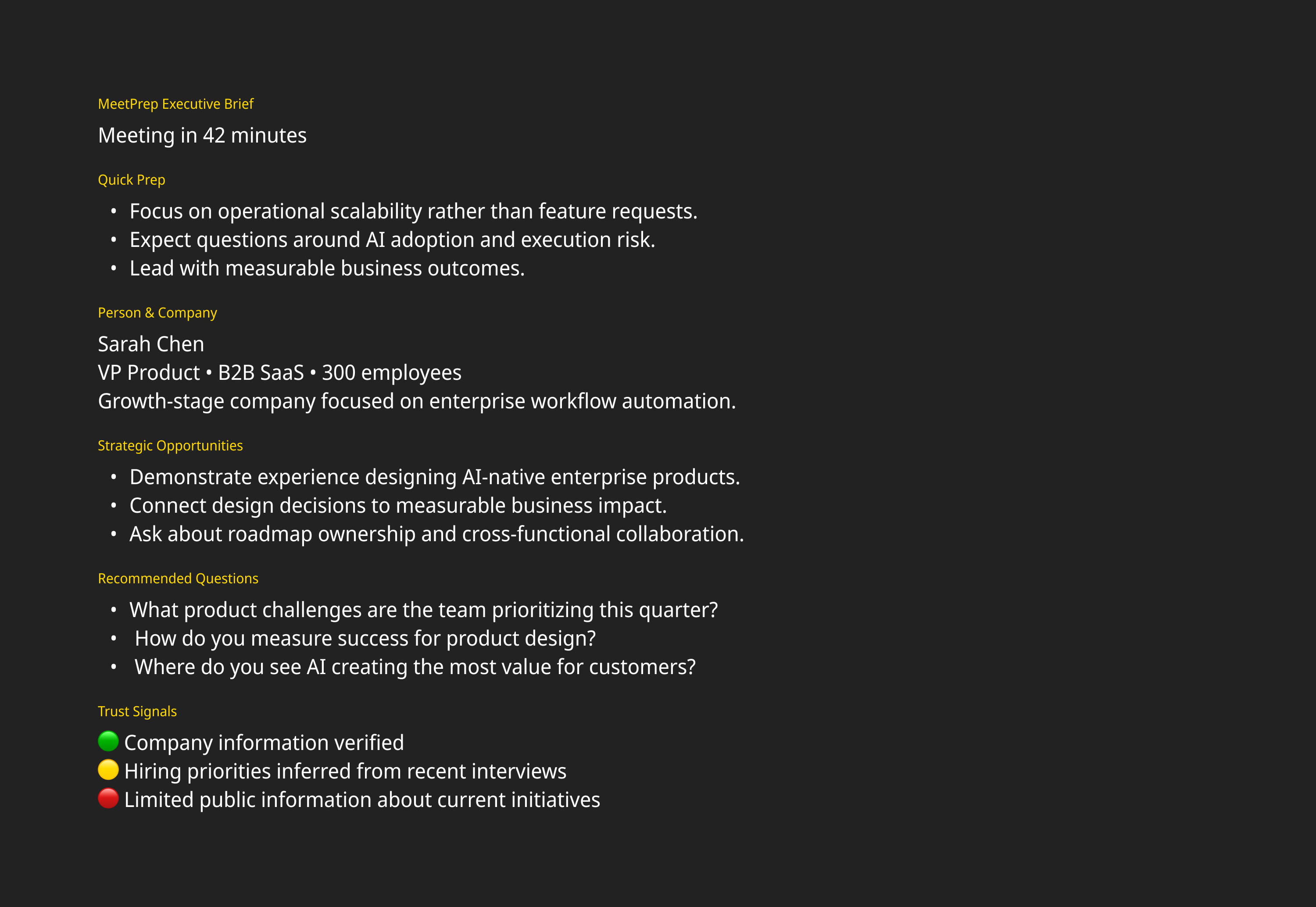
System Structure to Real Output Mapping
Designed for 30 to 60 second decision-making
Sample Generated Briefing
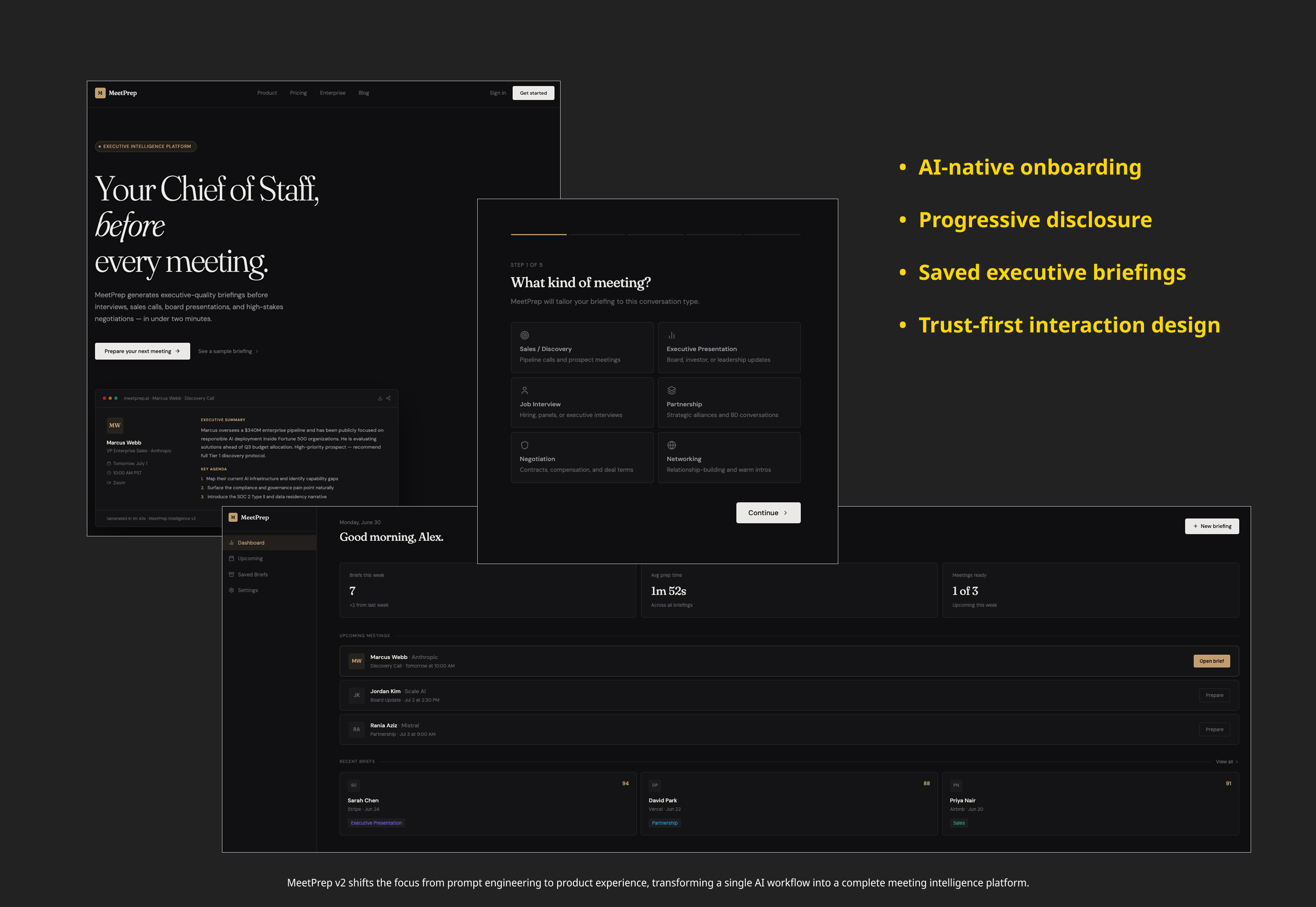
Product Screens
No 6What's Live, What's Next
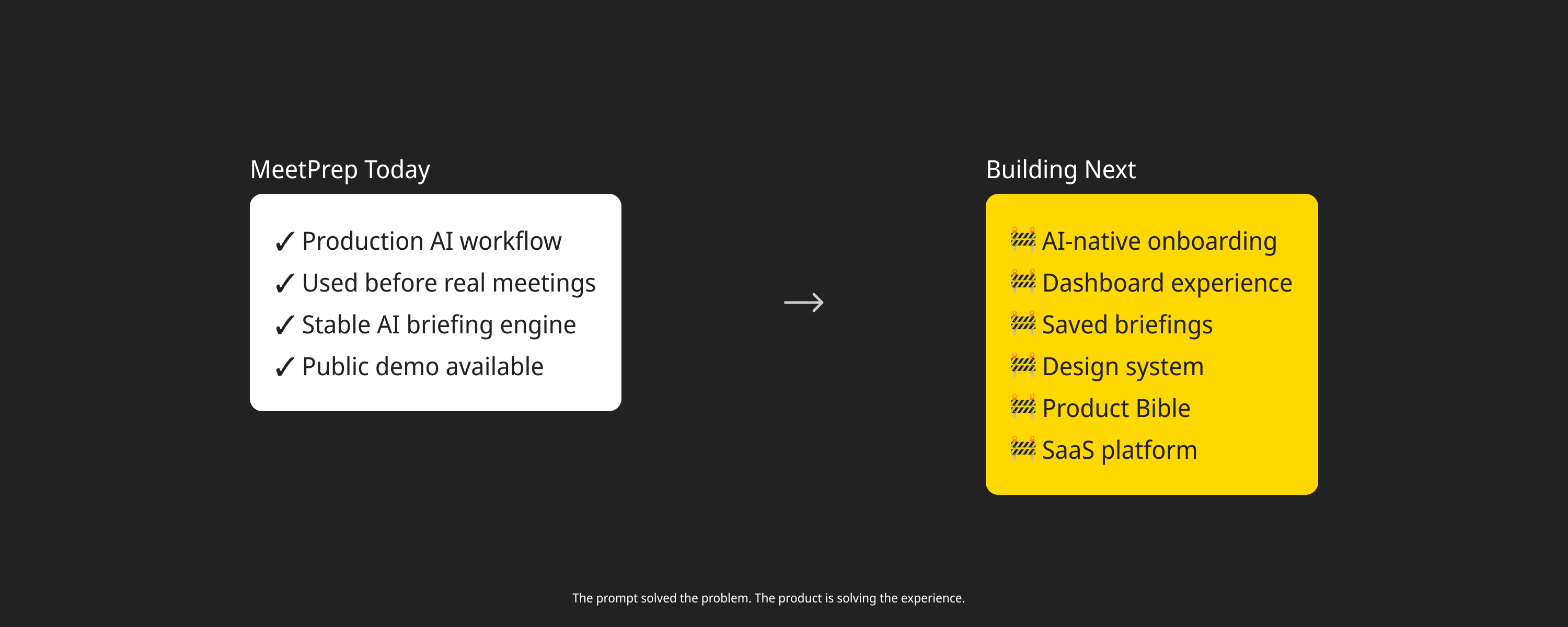
The original version of MeetPrep focused on proving that AI could generate high-quality executive meeting briefings. After extensive testing across interviews, executive meetings, networking, sales, negotiations, board meetings, and performance reviews, the briefing engine reached a level of quality where prompt engineering was no longer the bottleneck.
The project has now entered a new phase. Rather than continuing to optimize prompts, the focus has shifted toward designing MeetPrep as a complete AI-native SaaS product where the overall user experience becomes the competitive advantage.
Current Work in Progress
- Building an in-app result display, so briefings show up in the product itself instead of email-only.
- Adding download and share options for a completed briefing.
- Offering optional email delivery via a "close this tab" checkbox for users who'd rather not wait on-screen.
- Basic bot-abuse protection on the public intake flow.
- A pricing model.
Current Product Status
- ✅ Production-ready AI briefing engine (two-pass reasoning-then-writing architecture)
- ✅ Stable prompt architecture
- ✅ Extensive scenario testing, including planted-detail verification
- ✅ AI-native onboarding redesign — live, multi-step wizard at getmeetprep.com
- ✅ Landing page redesign — live at getmeetprep.com
- ✅ Working design system — shared CSS tokens and reusable components, not yet formally documented
- ✅ Sample briefing preview before intake
- 🚧 In-app result display (still email-only)
- 🚧 Download and share options
- 🚧 Optional "close this tab" email-delivery flow
- 🚧 Bot-abuse protection
- 🚧 Pricing model
The live version below demonstrates v1, the original briefing engine that proved the concept. The redesigned experience, wizard onboarding, landing page, and design system, is live today at getmeetprep.com; what remains is bringing results in-app instead of email-only.
Experience the live product:
No 7Product Vision
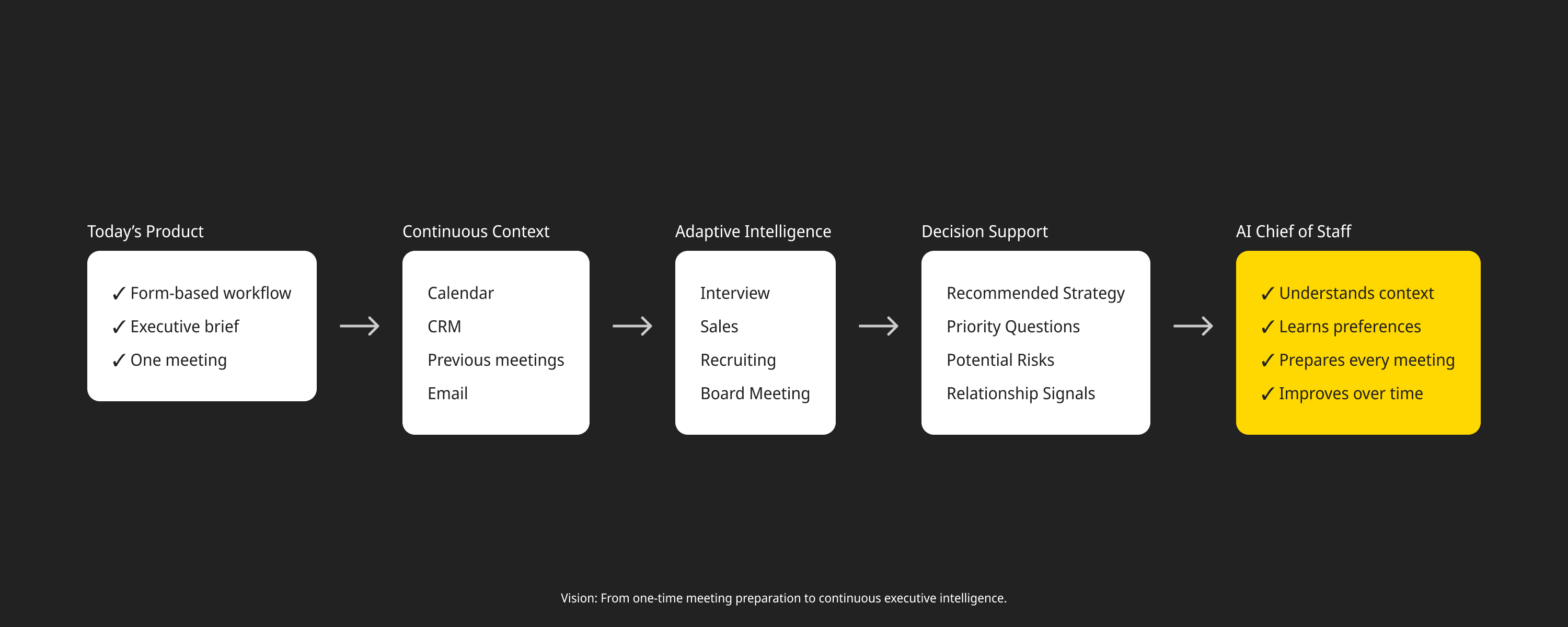
From Event-Based to Continuous Intelligence
The current system is triggered by a single form submission
→ Future systems pull from CRM, calendar, and interaction history
→ Context becomes a continuously updated layer, not a one-time input
From Static Output to Adaptive Briefings
Output should adjust based on meeting type and user intent
→ Sales, hiring, investor, internal sync
→ Same system, different framing
Personalization Without Fabrication
Move from guessed personalization to real signals
→ Past interactions, known preferences, actual data
→ Trust increases as system earns context
User Actions as System Signals
What users edit, ignore, or act on becomes training data
→ Inline editing lets users shape output before it is finalized
→ System improves relevance over time through real usage patterns
From Output to Decision Support
The goal is not better summaries
→ It is better decisions in less time
→ Briefings evolve into actionable guidance systems
Trust as a First-Class System Layer
Confidence, sources, and uncertainty become core primitives
→ Not a feature added later
→ Foundation for adoption in enterprise environments
Beyond Any Single Tool
The design principles developed for MeetPrep extend beyond this product
→ Output governance, trust signaling, and anti-hallucination logic apply directly to CRM workflows, sales intelligence, and internal AI systems
MeetPrep v1 proved the concept. v3, live today at getmeetprep.com, is the production evolution of that idea.
Try MeetPrep →